
A new provider joins a practice.
The schedule starts filling up.
Patients are ready.
The team is excited.
Then someone asks the question:
“Are we fully credentialed with the insurance plans?”
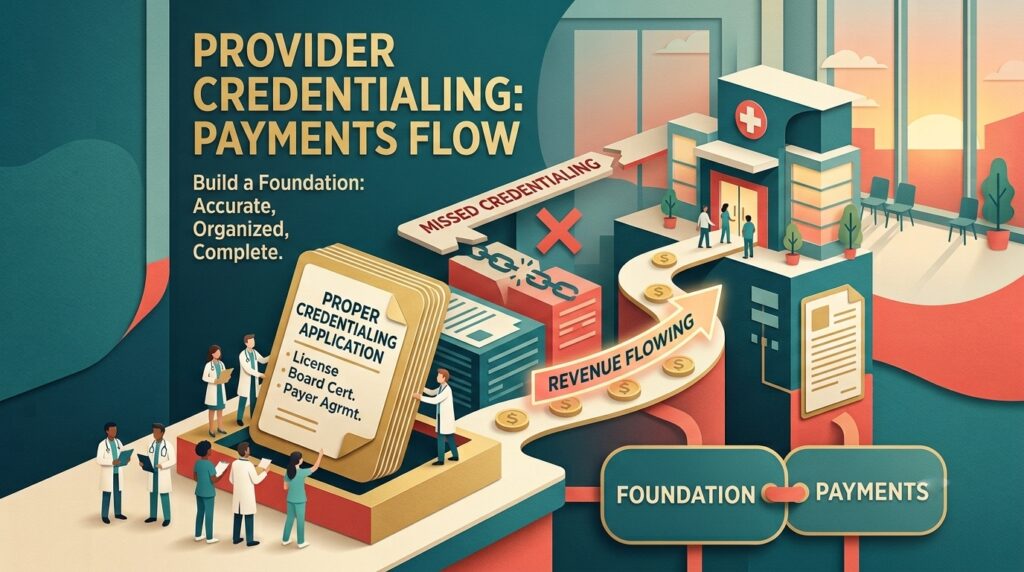
That one question can determine whether revenue starts flowing—or whether payments are delayed for months.
Credentialing Is More Than Paperwork
Many people view credentialing as administrative work.
Forms. Applications. Documentation.
But credentialing is actually the foundation of a provider’s ability to participate in insurance networks and receive payment.
Without proper credentialing, a provider may be seeing patients but creating billing challenges that affect the practice financially.
Small Mistakes Can Create Long Delays
Credentialing requires accuracy.
A missing document.
An outdated license.
An incorrect provider detail.
A missed follow-up.
Any of these can delay approval.
The challenge is that these delays often appear later—after the provider has already started seeing patients.
By then, the practice is trying to solve a problem while revenue is already being impacted.
Successful Practices Start Early
The best approach is proactive.
Strong credentialing processes include:
- Starting applications early
- Keeping provider information updated
- Tracking payer requirements
- Following up consistently
- Maintaining organized documentation
Credentialing should not be treated as a one-time task.
It is an ongoing part of practice operations.
Revenue Begins Before the First Claim
Many people think revenue cycle management begins when a claim is submitted.
It actually starts much earlier.
It begins with:
- The right provider information
- The right insurance participation
- The right processes
A strong foundation makes everything that follows easier.
The goal is simple:
When providers deliver care, the administrative systems should be ready to support payment.
Because providing excellent care is the priority—but getting paid properly allows practices to continue providing that care.